

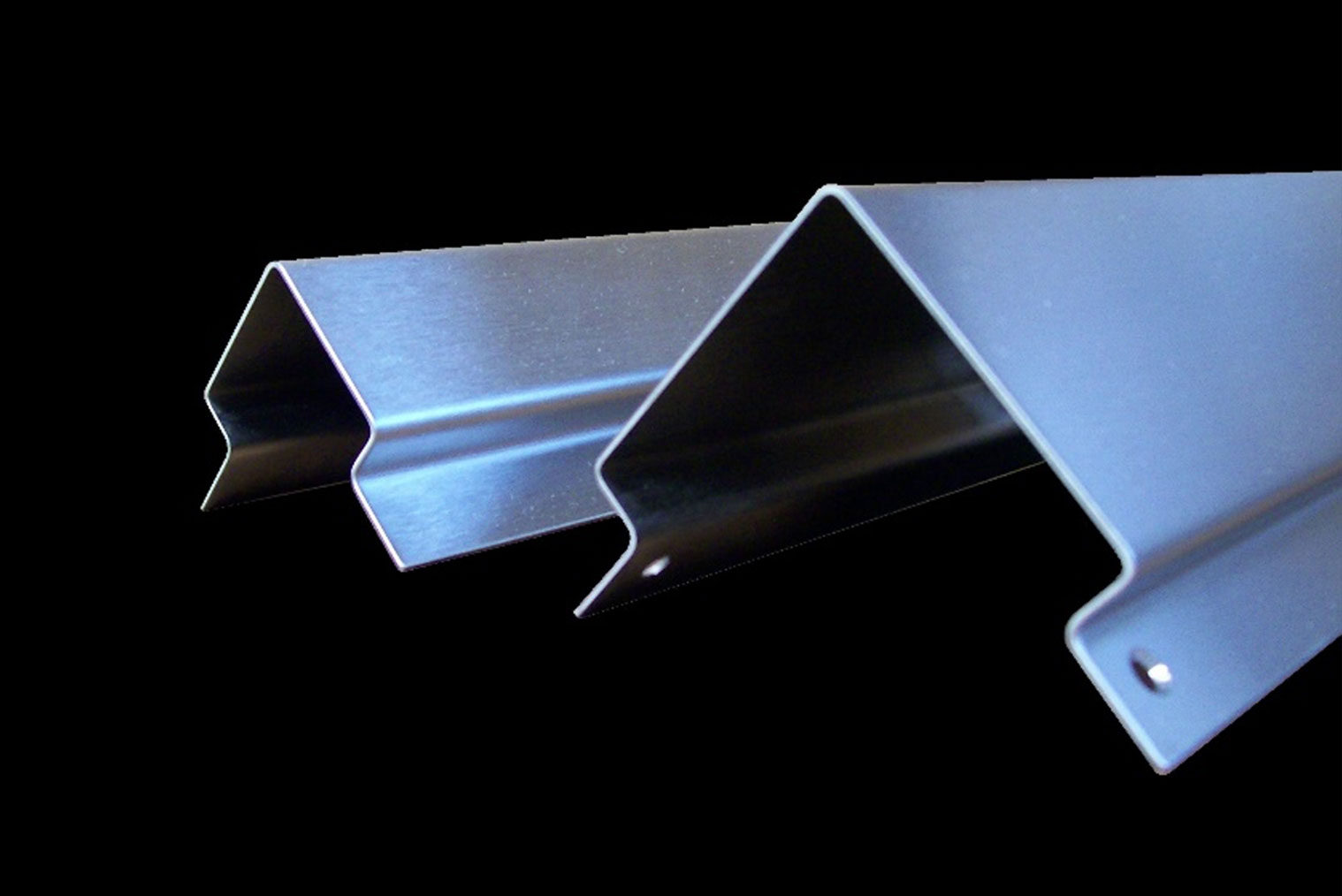
02 Jul Metal Corner Guards and Wall Guards: Custom vs. Off-the-Shelf
Metal corner guards and wall guards are among the more straightforward products in the architectural metals world…until they’re not. For a standard application in a standard space, an off-the-shelf product from a Division 10 supplier does the job reliably and cost-effectively. But commercial construction is full of conditions that aren’t standard, and the gap between a catalog product and the specific needs of the job is where custom fabrication earns its place.
Understanding when to specify standard and when to go custom, and what the tradeoffs look like in each direction, is the kind of practical knowledge that saves time, budget, and frustration on projects where the details matter.
What Off-the-Shelf Gets Right
Let’s start with the honest case for standard products, because it’s a real one.
Off-the-shelf corner guards and wall guards from established Division 10 manufacturers are well-engineered for the applications they’re designed to handle. They come in standard heights, standard gauges, standard profiles, and a range of standard finishes. They are available through distribution channels with predictable lead times. They’ve been installed in thousands of buildings and their performance characteristics are well understood.
For the vast majority of straight corridor applications in hospitals, schools, office buildings, and retail spaces, a standard product may be the right answer. The geometry is straightforward, the dimensions work, the finish matches the spec, and the installation is routine.
The economics are also straightforward. Standard products are priced for volume production and often cost less than custom fabricated parts for the same linear footage. When the application is truly standard, and when the delivery date coincides with the need date, there is no reason to pay a fabrication premium for something a catalog product handles well.
Where Standard Products Hit Their Limits
The challenge is that commercial spaces are not always designed around standard product dimensions. And when the design deviates from what the catalog offers, the options narrow quickly.
Unusual heights. Standard corner guards typically come in fixed heights (48, 60, and 96 inch heights are common). When the design calls for a guard that runs floor-to-ceiling in a space with a 10-foot, 11-foot, or 12-foot ceiling, the catalog options either fall short or require field splicing that compromises both appearance and performance. Custom fabrication produces a single piece cut to the exact height the space requires.
Non-standard profiles. The corner guard profiles offered by most manufacturers are designed for typical 90-degree inside and outside corners. Spaces with non-standard angles (i.e., obtuse corners in lobbies, angled corridors, and curved walls) require profiles that simply do not exist in a catalog. A custom fabricator can produce a guard that matches the exact geometry of the space.
Finish matching. This is one of the most common reasons interior designers and architects turn to custom fabrication. Standard products come in standard finishes such as brushed stainless steel or anodized aluminum. When the design intent calls for a specific paint color, a custom powder coat, or a finish that needs to match an adjacent material exactly, standard products can’t deliver. A custom fabricator works from the actual finish specification.
Gauge and impact resistance. Standard corner guards are engineered for typical impact loads. In environments with heavy equipment, such as loading docks, manufacturing facilities, and hospital service corridors, the impact demands may exceed what a standard gauge product is rated for. Custom fabrication allows the gauge to be specified to match the actual performance requirement.
Integration with other custom elements. When a space includes other custom metal elements like reception desk cladding, panel systems, or ceiling features, standard corner guards can look like they belong in a different building. Custom fabrication allows the corner guards to be coordinated with the other metalwork in the space, using the same material, the same finish, and the same design language.
The Cost Conversation
The honest answer on cost is that custom fabrication often costs more than standard products on a per-unit or per-linear-foot basis. That’s a real tradeoff and it belongs in the specification conversation.
However, the total cost of getting the look correct is worth consideration. For example, a standard product that requires field modification to fit a non-standard condition consumes installation labor and often produces a result that looks like exactly what it is: a product that didn’t quite fit. The cost of that labor, combined with a result that falls short of the design intent, can make custom fabrication the better economic choice even when the unit price is higher.
The calculation is straightforward: compare the cost of the standard product plus any field modification against the cost of custom fabrication that installs cleanly and looks right. For straightforward standard applications, standard wins. For the conditions described above, custom often does.
What to Bring to the Custom Fabrication Conversation
If a project has corner guard or wall guard conditions that look like candidates for custom fabrication, contact a customer fabricator with a profile sketch, the heights of each piece, quantities, the finish, and the gauge requirement if known. With this information, a custom fabricator can put together a quotation for you. For complex or unusual conditions, a photo of the field condition is worth more than a long verbal description.
Astro Sheet Metal fabricates custom metal corner guards, wall guards, and related Division 10 products for contractors and designers throughout the Dallas-Fort Worth and Austin markets. If you’ve got a project with conditions that don’t fit neatly into a catalog, we’re glad to take a look and tell you what’s achievable. Reach out at 972-438-1110 or at astrosheetmetal.com/contact.
Astro Sheet Metal Co., Inc. has been fabricating custom architectural metals in Grand Prairie, Texas since 1967. We serve architects, interior designers, general contractors, and specialty contractors across the Dallas-Fort Worth and Austin markets.