

25 Sep The Hidden Costs of the Lowest Metals Bid
Every general contractor knows the pressure. Bid day arrives, the numbers come in, and the owner wants the project delivered at the budget they approved. The lowest number in each scope gets circled. The job gets awarded. And somewhere between bid day and substantial completion, a few of those lowest bids reveal why they were the lowest.
Architectural metal is one of the scopes where the gap between bid-day savings and project-day reality shows up most often. Metal is a precision product, fabricated to specific dimensions, specific tolerances, and specific finish standards. When any of those items does not meet the mark, a shim or a tube of caulking often will not fix the problem. More often than not, it becomes a reorder, a delay, and a conversation about who is paying for it.
That is not to say that competitive bidding and cost discipline are not valuable. Both are legitimate and necessary. However, buyers should take the time to understand what is actually in a metals bid (and what might not be) before the number gets circled.
What the Lowest Bid Is Usually Leaving Out
Low metals bids do not come from nowhere. They come from specific decisions about how the work will be priced and executed. Here are the most common ones.
Lighter gauge than the spec requires. Gauge is one of the easiest places to shave cost on a metals bid. The difference between .125” and .063” aluminum is meaningful in terms of material cost across a large order. A fabricator who defaults to lighter material due to a lack of specificity on the architectural plans can come in below competitors while delivering material that performs differently than what was expected.
The submittal drawings will tell the tale. A fabricator who bids light on gauge will eventually have to submit shop drawings showing the gauge they are proposing. The time to catch that is during submittal review, not when the material arrives on site.
Substituted finish system. The difference between a 70% PVDF coating and a standard polyester paint is meaningful in both cost and long-term performance. A fabricator who substitutes a polyester system where PVDF was specified can reduce their cost significantly, and even if their paint technically complies with the written spec even if it does not match the design intent.
Again, the submittal is the checkpoint. It is also helpful to have your fabricator submit a physical finish sample for approval before production begins, so that substitutions can be caught before production ramps up.
Reduced quality control. Quality control steps cost time and money. A fabricator who skips or shortcuts these processes can produce and ship faster, which reduces their cost. The transfer of risk to the general contractor happens quietly, in the form of orders that occasionally arrive wrong and require reorders, revisions, or field modifications.
This one is harder to see in a bid than gauge or finish. It shows up more profoundly in the fabricator’s track record. Does the fabricator have a reputation for delivering thorough submittal drawings and accurate orders in a timely manner? References from comparable projects are the most useful tool for assessing quality and consistency before award.
Compressed lead times that are not actually achievable. A fabricator who quotes an aggressive lead time to win the bid and then delivers late has transferred a scheduling cost to the general contractor that was not visible on bid day. In a market as active as DFW right now, a shop that is already running at capacity and quotes a two-week lead time to win the order may have known on bid day that two weeks was not realistic.
The mitigation is to ask specifically how the fabricator plans to hit the quoted lead time given their current workload. A fabricator who can answer that question specifically, with reference to their actual capacity, is different from one who gives a number and hopes for the best.
The Math Behind the Hidden Costs
It is worth taking a moment to understand the true cost of making a wrong order, because the numbers are instructive.
Consider a glazing contractor who has a crew on site to install storefront brake metal. The material arrives and a portion of it is wrong: wrong leg length, finish on the wrong side, or some other issue that cannot be worked around in the field. The crew cannot complete the installation. Call it half a day of crew downtime while the problem is identified and a reorder is placed. Then the reorder takes a few days to arrive. The crew comes back to finish.
The direct cost of that scenario (crew downtime, return trip, expedite charges on the reorder) can easily run $2,000 to $5,000 depending on crew size and travel. On a brake metal order that might have been $800 cheaper from the low bidder, the math inverts quickly.
And that is only the direct cost. It does not include the general contractor’s time managing the problem, the downstream schedule impact on other trades, or the erosion of the relationship with the glazier who had to make the call explaining why their installation was delayed.
How Experienced General Contractors Evaluate Metal Bids
The general contractor who consistently get good outcomes on metals scopes tend to approach bid evaluation the same way: price is one input among several, not the only input.
The evaluation framework that works looks something like this:
Is this fabricator set up to do this specific scope? Equipment, experience with comparable projects, and capacity to handle the volume are baseline qualifications that price does not address.
What does their track record look like on similar work? References from comparable projects, with specific questions about accuracy, lead time reliability, and problem solving, provide information that a bid number does not.
Is the bid apples-to-apples? Look at details like the gauge, the finish, and the lead time. Does the lower bid actually cover the same scope of work as the higher bid?
What’s the cost of failure for this specific scope? Considering the fact that architectural metals are often one of the last items installed on a construction site, long after any slack time in the schedule has been eaten up by the other trades, ask yourself: If this metal arrives wrong, how will it affect the winding down of this project? Those stakes can help you decide how much weight to give to price versus track record in the evaluation.
The Relationship Premium
There’s one more cost that doesn’t show up in any line item but that experienced general contractors account for: the value of a vendor relationship that works.
A fabricator who knows your business, processes your orders accurately, communicates proactively when something changes, and shows up for you when a schedule gets compressed is worth a premium over the spot market. That premium shows up in orders that arrive right the first time, in lead times that are honest rather than optimistic, and in the problem-solving that happens when a job throws an inevitable curveball.
The lowest bid on bid day is a number. A reliable fabricator relationship is an asset that pays dividends on every job it touches. Experienced GCs who have built those relationships with their architectural metal partners tend to keep them, even when a new bidder comes in lower, because they have done the math on what the relationship is actually worth.
Astro Sheet Metal has been building those relationships with general contractors across the Dallas-Fort Worth and Austin markets for nearly 60 years. If you are evaluating metal fabricators for an upcoming project and want to understand what Astro brings to the table beyond the bid number, reach out to us at 972-438-1110 or at astrosheetmetal.com/contact.
Why Existing Metal Is Difficult to Match
The original drawings are not always available, and even when they are, they may not reflect what was ultimately installed.
Contractors frequently encounter conditions that have changed through years of repairs and renovations. A profile shown on an old detail may have been modified in the field. A painted finish may have faded. Sealant joints may have been covered. Fasteners may have been replaced, and layers of roofing or wall material may have been added around the original metal.
The existing component may also have been produced by a manufacturer that is no longer in business or from an extrusion that is no longer offered.
Common matching challenges include:
- Nonstandard bends and dimensions
- Materials of uncertain type or thickness
- Faded or weathered finishes
- Profiles concealed behind adjacent construction
- Irregular substrates
- Previous field modifications
- Missing shop drawings
- Components that vary from one area of the building to another
The first step is therefore not fabrication. It is documentation.
Start With the Existing Condition
Older buildings should be measured as they exist, not as the original drawings suggest they should exist.
This may require more than recording the visible width and height of a component. The fabricator may need to understand how the piece attaches, where it overlaps adjacent material, how water is directed and whether the existing profile conceals clips, cleats or other supports.
When possible, the project team should provide:
- Overall dimensions
- Close-up and wide-angle photographs
- Material thickness or gauge
- Finish information
- Details of adjacent construction
- Attachment locations
- The number of pieces required
- A physical sample of the original component
A removed piece is often the most useful reference. It allows the fabricator to verify dimensions, bend angles, hems, returns, material thickness and finish orientation directly.
Field verification remains important even when a sample is available. Architectural metals are often installed after several other trades, which means they must accommodate the combined tolerances of the completed framing, masonry, glazing, roofing or millwork. Astro’s existing coordination guidance emphasizes that “hold-to” dimensions do not always match the final field condition.
Recreating an Existing Profile
Many older metal profiles can be reproduced using modern shearing, braking, rolling and welding equipment.
A custom brake shape may be relatively straightforward if the original piece was formed from flat sheet. The fabricator can measure the existing legs, bends, hems and returns and then create a new profile based on those dimensions.
More complicated components may require:
- Multiple formed pieces welded into one assembly
- Custom cleats or attachment brackets
- Curved or segmented construction
- Removable access panels
- Reinforcing behind broad surfaces
- Shop-built corner conditions
- Transition pieces between different profiles
An exact duplicate is not always the best solution. Older details may have performed poorly, trapped water or depended on attachment methods that are no longer practical. The project team may decide to preserve the visible appearance while improving the concealed construction.
That distinction should be made early. Is the goal to create an exact historical reproduction, a close visual match or a new component that simply works with the existing architecture?
Each objective can lead to a different fabrication approach.
Matching the Finish Is Often Harder Than Matching the Shape
Metal profiles can usually be measured. Finishes are less predictable.
Exterior metal changes over time. Painted surfaces fade from sunlight. Clear coatings weather. Copper and other metals develop patina. Stainless steel collects scratches and cleaning marks. Anodized aluminum may change in appearance depending on age, exposure and viewing angle.
A new finish produced to the original specification may therefore look different from the material currently on the building.
This does not necessarily mean the new finish is wrong. It may mean the existing finish has changed.
The best matching process usually involves physical samples rather than relying on a color name, photograph or old specification. Photographs are useful for context, but lighting, camera settings and computer screens can make finish comparisons unreliable.
Depending on the project, the fabricator or finisher may prepare samples showing:
- Paint color and gloss
- Powder-coat options
- Brushed or directional grain
- Anodized appearance
- Patinated or chemically treated finishes
- Clear-coated versus uncoated material
- Alternative finishes that coordinate without pretending to be identical
The owner, architect and contractor should review those samples beside the existing building under actual site lighting whenever possible.
Decide Whether to Match or Complement
Sometimes the best design decision is not to pursue an imperfect match.
A nearly identical finish can make small differences more noticeable. When an exact match is unrealistic, a deliberate contrast may look more intentional.
For example, a renovation might use a darker metal at the new entrance, a different panel module on the addition or a contrasting trim profile to distinguish new construction from the original building. This approach can respect the existing architecture without creating a false impression that every component was installed at the same time.
The right strategy depends on the project.
Historic restoration may require a close reproduction. A commercial repositioning may benefit from a clearly contemporary addition. A limited repair may need to blend as quietly as possible with surrounding material.
That conversation should happen before pricing and fabrication, because “match existing” can mean very different things to different members of the project team.
Finish Direction and Batch Consistency Matter
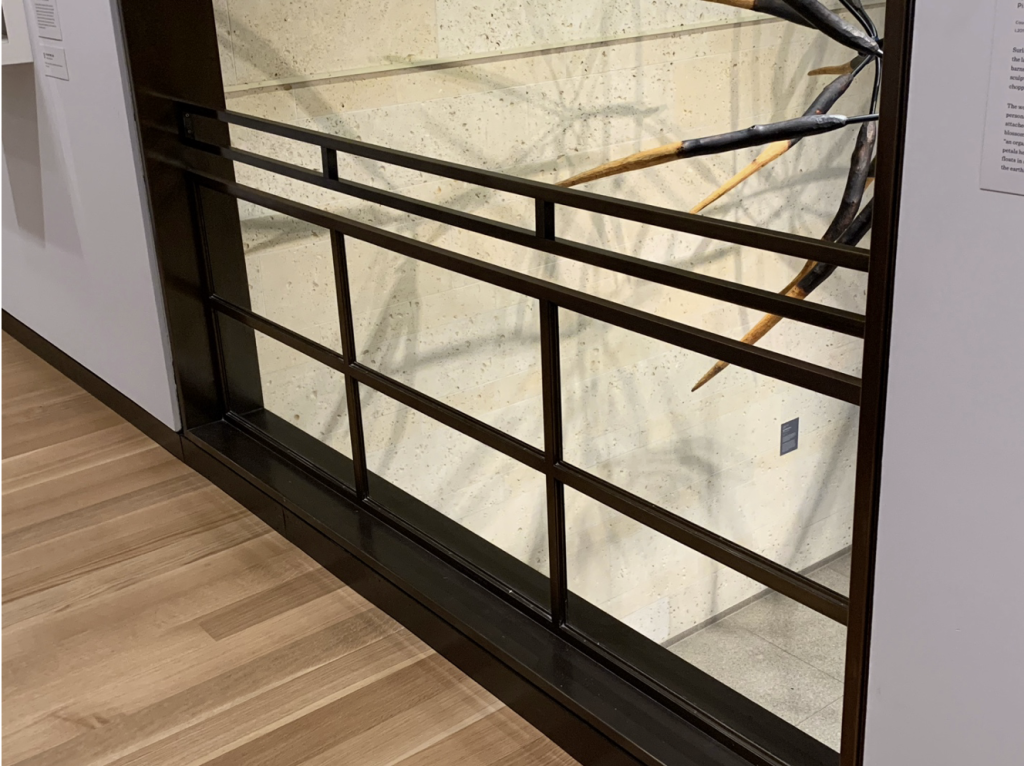
Directional metals such as brushed stainless steel can appear noticeably different when one piece is rotated.
Even when the material and finish are technically the same, inconsistent grain direction can cause adjacent panels to reflect light differently. Painted and anodized finishes may also vary between batches.
Large surfaces magnify those differences. Astro’s guidance on metal feature walls stresses the importance of controlling grain direction, coordinating finish batches and planning panel joints carefully.
Replacement components should be clearly marked so installers understand their intended orientation. When several new pieces will be placed together, producing and finishing them as one coordinated batch can improve consistency.
Watch for Dissimilar Materials
Renovations often bring old and new metals into direct contact.
That can create problems when dissimilar metals are exposed to moisture. Aluminum, steel, stainless steel, copper and galvanized material do not always interact well when placed together without appropriate separation.
The visible match is therefore only part of the detail. The project team should also consider:
- Compatibility between old and new materials
- Isolation between dissimilar metals
- Existing waterproofing
- Drainage paths
- Sealant compatibility
- Concealed corrosion
- Condition of supporting clips and fasteners
A decorative cover installed over a deteriorated attachment system does not solve the underlying problem. Existing substrates and concealed supports should be evaluated before the replacement metal is finalized.
Small Orders Can Require Significant Work
A renovation may need only three replacement panels or 20 feet of custom trim. That does not necessarily make it a simple order.
Small quantities can require the same field investigation, drawing, setup, material sourcing and finish coordination as a much larger scope. A unique profile may need to be programmed and tested. Specialty material may have minimum-order requirements. A custom finish may need to be processed separately from other work.
Providing complete information helps the fabricator assess the request accurately. A profile sketch, photographs, dimensions, quantity, material preference and physical sample can save several rounds of clarification.
It is also wise to fabricate spare pieces when the profile is difficult to reproduce. Producing an extra component during the original setup may cost much less than recreating the order years later.
Fabrication-Only or Turnkey?
Some renovation scopes work well as fabrication-only orders.
An experienced roofing, glazing or millwork contractor may already understand the field condition and simply need replacement pieces manufactured from an approved sketch or sample. The completed material can then be picked up or delivered for installation.
More complicated renovations may benefit from a turnkey approach. When the condition requires field measurement, shop drawings, coordination with adjacent trades and specialized installation, keeping those responsibilities with one metal contractor reduces the number of handoffs.
Astro Sheet Metal offers both options. Fabrication-only components can be picked up from its Grand Prairie shop or delivered to a customer or jobsite. Turnkey packages can include site visits, field measurement, submittal and shop drawings, fabrication and installation.
Supporting the Next Life of North Texas Buildings
Renovating an older building often requires more problem-solving than starting with an empty site.
Existing conditions are rarely perfect, original information may be incomplete and the finish everyone wants to match may have spent decades changing in the Texas sun. Success depends on documenting the condition carefully, establishing realistic expectations and involving the fabricator before the solution has been fully locked in.
Astro Sheet Metal has fabricated custom architectural metals in Grand Prairie since 1967. During that time, the Dallas-Fort Worth area has changed dramatically, and Astro has continued to expand its equipment and capabilities while maintaining its focus on quality, proficiency and customer service.
Whether a project requires one unusual replacement profile or a complete architectural metal package for an adaptive-reuse development, the same principle applies: understand what is there before deciding what needs to be made.